Anthony LaVacca, DMD Blog | What Does A Beautiful Smile Mean to you?

TAG | dentures

Malocclusion is more commonly known as crowded teeth, cross bite, overbite, under bite, or open bite. It is simply the misalignment of teeth. It is a common problem seen in most people at least to some degree.

How to identify Malocclusion
Even though most people do not have perfect alignment of their teeth, for some, the misalignment causes other more noticeable problems. A dentist should be consulted if any of the following symptoms occur together with poor alignment of teeth, in order to effect a proper diagnosis and treatment of Malocclusion.

▪   pain arising from pressure to the jaw

▪   problems in speech and ability to eat

▪   breathing through the mouth

▪   difficulty in keeping the lips closed

Types of Malocclusion
In 1899, Edward Angel identified three different categories of Malocclusion:

▪   Class I Malocclusion : This is the more widespread type of Malocclusion. In this type, the first molars are normal. However the other teeth are affected by problems in spacing, crowding, and over/ under eruption.

▪   Class II Malocclusion : In this type of Malocclusion the upper molars significantly overlap the bottom teeth.

▪   Class III Malocclusion : This is the inverse of class II where the lower jaw protrudes more than the upper, causing the bottom front teeth to overlap the upper ones

Causes of Malocclusion

Malocclusion can either be inherited from parents or acquired through bad habits:

Inherited Malocclusion : This is mostly the case. This type of Malocclusion is evident in there being less or more teeth, or space between the teeth, than appropriate. It is caused by irregular jaw size or shape or by unusual formations like cleft palates.

Acquired Malocclusion : A major cause of acquired Malocclusion is bad habits. The bad habits that children mostly succumb to, such as thumb/ finger sucking or tongue thrusting, are causes of Malocclusion. As such, monitoring of such bad habits by the parents and controlling the same can easily prevent this type of Malocclusion occurring.

Treatment of Malocclusion

▪   Use of Braces

▪   Malocclusion is commonly treated by using dental braces. The constant and gently pressure provided by braces will enable teeth straightening and help push teeth back to their correct position.
Braces consist of brackets that are fixed to the teeth, and wires that connect the brackets. Since the braces cannot be removed, extra attention should be paid in keeping the teeth clean and getting rid of food particles that are likely to get stuck in the braces.

▪   Removal of teeth

▪   This will help in instances of overcrowding, where it would make room for the other teeth to move to the correct position.

▪   Reshaping, and bonding or capping teeth

▪   This will treat rough or irregular teeth removing resistance in forming a proper bite.

▪   Surgery : Requirement of surgery is rare. Surgery can be used to reshape the jaw or to stabilize the jawbone through wires, plates or screws where required. 
Malocclusion can be treated in the majority of cases. Consulting a dentist early when Malocclusion is suspected can ensure the proper and effective treatment, which would help in maintaining proper dental health.

· · · · · · · · · · · · · · · · · · · · ·

One of the most popular and effective developments in cosmetic dentistry has been porcelain veneers- thin, durable shells that mask stains, gaps, chips, discoloration and other pesky dental blemishes. These natural-looking restorations have the ability to mimic natural tooth enamel, making them virtually indistinguishable from your existing teeth. With veneers, you can improve the shape, size, length and color of your teeth all in one simple procedure.

The Veneers Application

Before application, you will meet with Dr. LaVacca to discuss your goals for treatment and to determine the size, shape and color of veneers that will best fit your smile and expectations. The application of veneers involves your cosmetic dentist preparing your teeth by removing minimal tooth enamel from the surface in order to accommodate the porcelain shell. Dr. LaVacca will then take a mold of your teeth and mouth, which will be sent to a dental laboratory where your veneers will be custom-crafted for your unique smile. When you go back for your final appointment, he will permanently bond the durable and highly stain-resistant veneers to the front of your teeth, resulting in a stunning, new smile.

Benefits of Veneers

Porcelain veneers offer many advantages. Unlike traditional orthodontics, which can take years to complete, veneers produce a smile transformation in just a few appointments. Veneers are also typically longer-lasting than teeth whitening or dental bonding. With proper upkeep, they can last for several years. Other benefits include:

• Veneers look and feel indistinguishable from natural teeth
• Porcelain shells are custom-crafted to seamlessly match each patient’s desired tooth shape, size, color, and texture
• Porcelain is highly stain resistant and durable, making this option longer-lasting than most other cosmetic treatments
• Veneers are the ultimate smile makeover solution for numerous aesthetic flaws

Are You a Candidate?

Many patients can benefit from veneers, but not everyone is an ideal candidate. If you are missing teeth, need extensive orthodontic work or have weak teeth, other alternatives may be better suited for your needs. There are several other cosmetic treatments available, including, braces, Invisalign, bonding and teeth whitening that can enhance your smile.

If you’re interested in transforming your smile and your life, porcelain veneers from Naperville Dental Specialists may be the solution for you. It only takes a few appointments to obtain dramatic results and an increased self-confidence-an investment well worth it! Call today to make an appointment! 630-848-2010  www.ndscare.com

· · · · · · · · · · · · · · · · · · · ·

A great article by Steven Brazis

Who Needs Dental Implants?
By Steven Brazis
Over the past twenty years, dental implants have been constantly improving. The science and technology for dental implants now makes implants as predictable and reliable as more traditional dental restorative procedures like crowns and bridges.

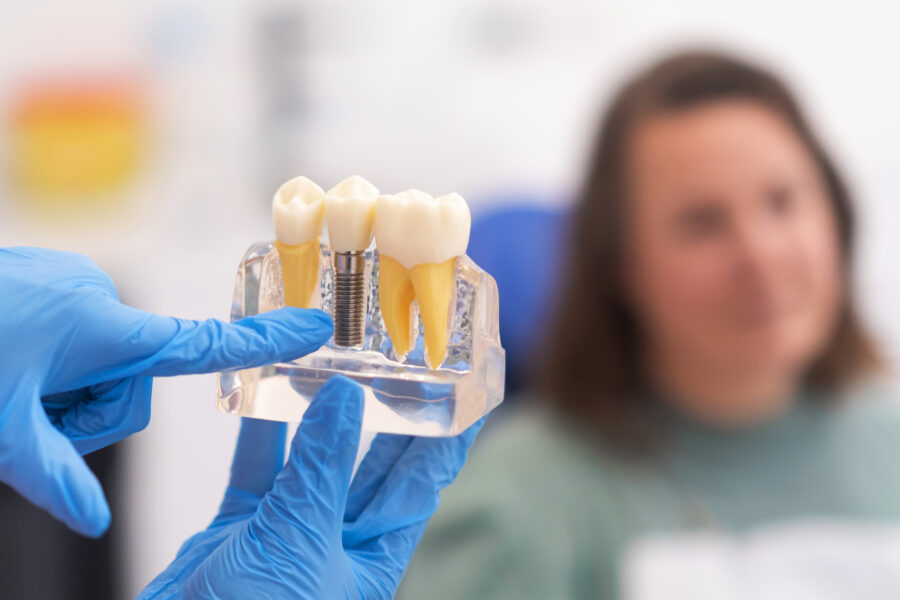
Implants are done in two distinct stages. A titanium artificial tooth root is surgically placed into the jaw bone by an oral surgeon, periodontist or general dentist with specialized training. The top of the implant is just below the level of gum tissue and exposed to the inside of the mouth by leaving a small hole in the gums. A “healing cap” is screwed into the threads of the implant to prevent the gum tissue from growing over or into the implant.

A period of 6 weeks to several months is required for the titanium implant to “integrate” with the jaw bone. That means that the bone actually attaches to the implant to provide stability. It should be realized that this attachment is NOT the same as with a natural tooth. There is no periodontal ligament involved, which is the feature in bone to tooth attachment that allows for tooth movement through bone. Implants cannot be moved orthodontically nor be exposed to forces that cause natural teeth to move in response. For this reason, if implants are being considered with multiple missing teeth, your dentist must plan the number of implants and type of restoration placed on the implants carefully.

The type of restoration placed on the implant are varied. In the case of a single tooth, a piece called an abutment is screwed into the implant to replace the healing cap when osseo-integration of the implant has been accomplished. A crown (or cap) is then cemented over the abutment just as if this were a natural tooth that had been prepared for a crown.

There can be several single tooth implants placed either adjacent to one another or in various locations around the mouth where teeth are missing. However, when the span of missing teeth is too great, it becomes more cost effective as well as biologically supportable to place two or three implants and link them together with a fixed bridge. There will be more teeth showing on the bridge than there are implants, just like with traditional bridges on natural teeth. These are also supported be abutments screwed into the implants as with single tooth implants.

When there are many missing teeth (or all of them) implants are usually used to support a removable denture. In these cases, several implants are linked together with a cast metal bar screwed into the implants on short posts. On the under side of the denture clips are inserted which clip onto the bar between the implants. A denture made this way is vastly more comfortable than a traditional denture because it largely rests on the bar instead of the tissue, thus eliminating many of the sore spots caused by dentures. Additionally, the denture is locked into place by the clips and is extremely stable, unlike dentures which tend to slip and shift or come completely out much more easily.

Although implants can be very expensive by comparison with other more traditional dental prosthetics, the potential benefits make them equally valuable. Most patients who have had traditional dental prosthetics replaced by implant supported prosthetics are so happy that they would never go back.

Dr. Steven Brazis has practiced family and cosmetic dentistry for 35 years. His practice is in Sacramento, CA. He has written extensively on dentistry for the lay person.

· · · · · · · · · · · · · · · · · ·

Jan/11

12

It’s That Time Again!!

Naperville Magazine is conducting their third annual “Best of Naperville Magazine Awards” You vote, You decide, and they will publish the winners in the August 2011 issue. There are forty categories to vote for, covering everything from best burger to best dentist. Remember, you choose the winner!  Each person is able to cast 10 votes.

If you LOVE your dentist/orthodontist

  • Log on to www.napervillemagazine.com
  • In the upper right corner click – “Click here to vote”
  • In the bottom left of the next screen click “Click here to login or register”
  • Login OR Click “Create new account”
  • You will be asked to create your own personal UserName and Password
  • Enter username, email address, and password then click on “Create New Account”
  • On next screen Click “Click here to vote”
  • All 40 categories will list
  • Go to Best Dentist/Practice and TYPE: Naperville Dental/Innovative Orthodontics
  • Click on Submit
  • Vote 10 times

THANK YOU for your support!!!

Also, congratulations to Naperville Magazine! The Tribune company has acquired the magazine which is great for them and area businesses!!! Way To GO!

· · · · · · · · · · · · · · · · · · · · · · · ·

Are you or a loved one living with painful dentures? Consider an alternative. Receive a free report on new technology to replace dentures for good!

http://www.napervilledentalimplantcenter.com/

· · ·

lavacca-blog

Welcome to Dr. LaVacca’s blog! Dr. LaVacca and his staff will make every effort to answer your questions and provide you with the latest information about oral health care.

Did you know, for example, that osteonecrosis has been found in a subset of patients receiving bisphosphonate therapy?

So, unless you experience this already or are another dentist… you’re probably wondering, What does that mean and who does this really affect.

Let me begin by saying that bisphosphonates are a class of agent that is used to treat osteoporosis.

Bisphosphonates currently available in the US according to Compendium, March 2008, are Alendronate (Fosamax®), Risendronate (Actonel®), Ibanadronate (Boniva®), Pamidronate (Aredia®), and Zoledronatic acid (Zometa®).

Benefits of bisphosphonate therapy include slowing the remodeling process and increasing bone mineral density which reduces the risk of fracture in women with osteopenia and osteoporosis.

It is only a small subset of patients that have emerged showing complications, but these complications are serious. As matter of fact in 2005 the US Food and Drug Administration issued a broad drug class warning on this complication that became known as BRONJ (Bisphosphonate related osteonecrosis of the jaws).

According to Merk & Co. (2008), incidence is only .7 cases per 100,000 person-years of exposure. And there is some evidence that it is the patients receiving the more potent IV bisphosphonate therapy may have higher risk.

So ..How can anyone tell if they suffer from BRONJ? Well, if you are currently or previously being treated with a bisphosphonate, if you have exposed, necrotic bone in the maxillofacial region that has persisted or have no history of radiation therapy in the jaws and have bony areas exposed in the maxillofacial area, according to the American Association of Oral and Maxillofacial Surgeons.

Bisphosphonates are deposited preferentially in bones with high rate of bone remodelling(the lifelong process where bone is removed from the body and new bone is added). The maxilla and mandible have high turn over rates which is why there may be higher levels of bisphosphonates within the jaws. There have been no other complications to date outside the craniofacial skeleton.

Most cases of osteonecrosis occur at the regions of extractions, but not all. Some patients have had no history of trauma. Patients with a history of inflammatory dental disease such as  periodontal and dental abscesses are seven times at risk.

Just another reason for maintaining good oral health!

If you or anyone you know suffer from BRONJ or have any questions about BRONJ, please do not hesitate to contact our office!

· · · ·

Theme Design by devolux.nh2.me